
The residential blocks of Love Field Estates, Maple Lawn, and the neighborhoods surrounding the Southwestern Medical District sit at an unusual intersection. To the east, Harry Hines Boulevard carries heavy commercial and medical traffic past UT Southwestern Medical Center, one of the largest medical and research campuses in the country. To the northeast, Inwood Road feeds into the medical campus and connects to Love Field. To the southeast, the I-35E Stemmons Freeway separates these neighborhoods from the Dallas Design District and the Dallas Market Center on N. Stemmons Fwy.
What this means for pool owners is that they live in a genuinely urban environment — with all the air quality, traffic, and particulate exposure that comes with it — while maintaining residential properties with backyard pools. The combination of urban airborne deposits settling into pool water and the notoriously hard Dallas municipal water supply creates an accelerated rate of surface degradation compared to suburban pools farther from major commercial corridors.
The neighborhoods between Harry Hines Boulevard and the Stemmons Freeway corridor were developed heavily in the 1950s and 1960s, when Dallas was expanding westward toward Love Field and the newly developing Medical District. Homes in Maple Lawn, Love Field Estates, and the Arlington Park area near Arlington Park Recreation Center on Record Crossing Road reflect that era — solid construction, mature yards, and pools that were installed anywhere from 20 to 50 years ago.
A pool that was resurfaced in the 1990s or early 2000s is now between 25 and 35 years out from its last finish. That's well past any reasonable service life for white plaster and even beyond the upper range for pebble finishes if they weren't maintained diligently.
The expansive black clay soil that runs under much of Dallas County is especially active in this central band of the city. As the soil beneath a pool shell wets and dries through the seasons — and Dallas swings hard between drought and heavy rain — the ground exerts enormous pressure on pool shells. Pools along the I-35E and Stemmons Freeway corridor sit above ground that has been disturbed by decades of heavy construction and infrastructure work in the area, which can compound the effects of normal seasonal soil movement on older pool shells.
Hairline cracks that start in the plaster surface often trace back to this underlying movement. Once those cracks form, water finds its way behind the finish layer — and the deterioration process speeds up dramatically.
If you're searching for pool resurfacing near me in the Medical District area or trying to decide whether your pool has reached that point, here are the most common indicators:
Choosing a resurfacing material isn't just an aesthetic decision. In a zip code like 75235, where hard municipal water and urban air quality create above-average demands on pool surfaces, material choice directly affects how long your investment lasts.
The baseline option. Plaster is smooth, clean-looking, and the most cost-accessible entry point. It holds up reasonably well in the short term but shows calcium scaling and staining faster than any other finish when exposed to Dallas's mineral-heavy water supply. Expect a 7–10 year useful life before the next resurfacing cycle if water chemistry is maintained carefully.
Same composition as white plaster, but with added pigment. Darker tones — charcoal gray, slate blue, and earthy beige are popular in this neighborhood — disguise mineral staining better than white finishes and give the pool a more designed appearance. A strong choice for homeowners in Love Field Estates and Maple Lawn who want to upgrade the look while keeping costs moderate.
Quartz finishes occupy a meaningful step up from plaster in both durability and water chemistry resistance. The harder surface is more resistant to etching from Dallas's high-calcium water and holds its finish significantly longer. A quartz resurfacing in this area, with conscientious maintenance, will typically run 12–18 years before the next cycle is needed.
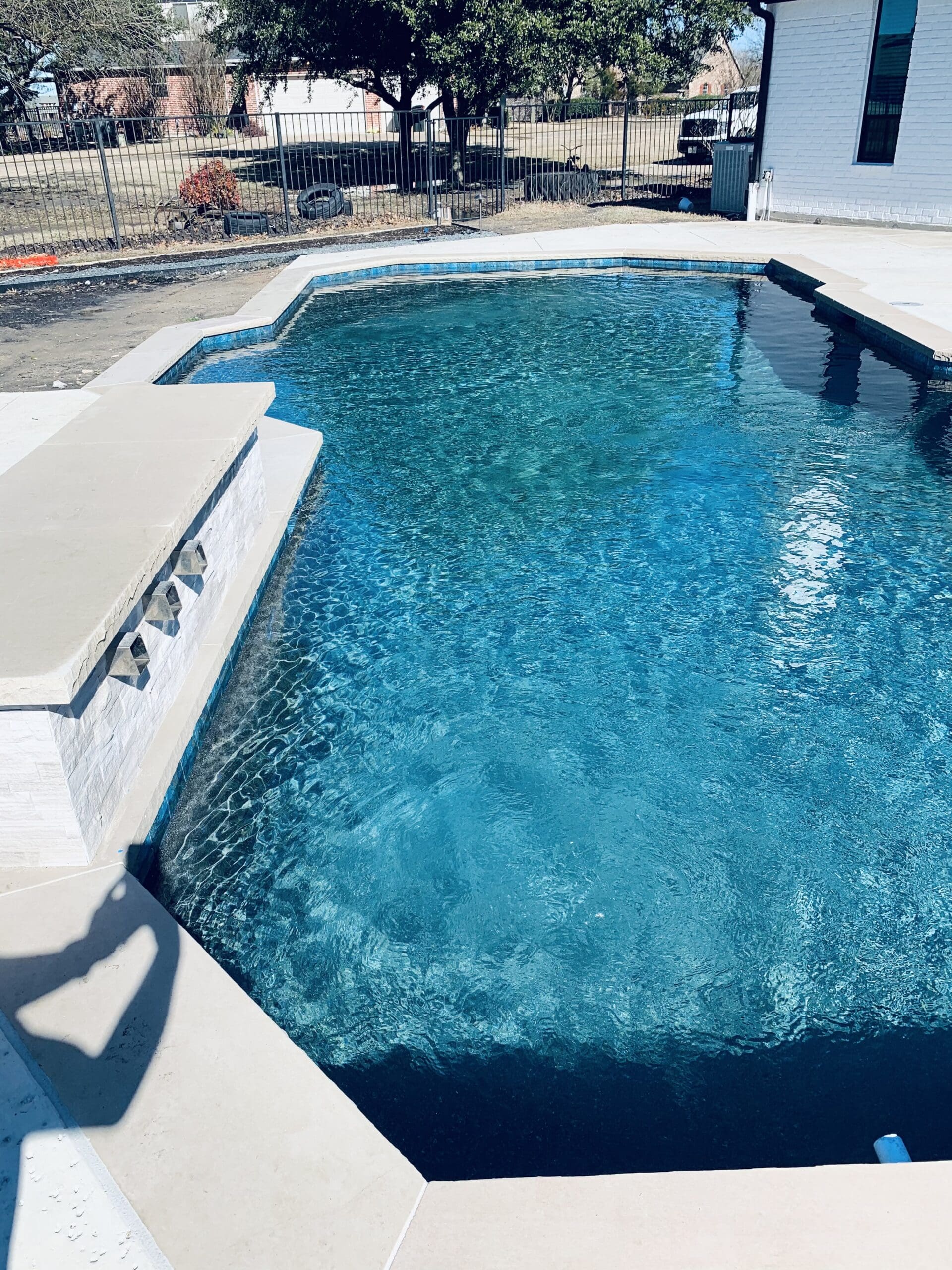
Pebble finishes — including PebbleTec, Pebble Sheen, and similar products — are the most resilient option available for residential pools in Dallas. They handle hard water chemistry better than any plaster or quartz product, and their surface texture makes calcium deposits far less visible over time. For homeowners in the Medical District and Love Field Estates area who plan to stay in their homes long-term, a pebble resurfacing is generally the most cost-effective choice over a 20-year horizon.
Premium finishes that incorporate glass beads or specialty aggregate create a visually distinctive pool surface — particularly striking when lit from below at night. Common in higher-end residential renovations and commercial properties in the area.
The stretch running along Harry Hines Boulevard, Inwood Road, and into the Stemmons Freeway corridor includes a significant density of commercial properties with pools — hotels near Dallas Love Field and the medical campus, multi-family apartment developments, and HOA-managed properties serving the large workforce that staffs UT Southwestern Medical Center and its affiliated facilities.
Commercial pool resurfacing in Texas carries regulatory requirements that go beyond what's expected for a residential job. The Texas Department of State Health Services mandates minimum surface smoothness and finish integrity standards for public and semi-public pools. When a commercial pool's surface deteriorates to the point of roughness or visible cracking, property managers face both a guest safety issue and a compliance exposure.
Dallas Pool Resurfacing & Plastering handles commercial resurfacing projects throughout the Medical District area, from multi-unit residential pools along the Harry Hines corridor to hospitality properties near Love Field. We work with property managers on scheduling and documentation to minimize operational downtime and maintain compliance.
The neighborhoods around Grauwyler Park on Harry Hines Boulevard, Arlington Park, and the residential blocks near Reverchon Recreation Center on Maple Avenue tend to have older pools that have been through multiple ownership cycles. In those situations, resurfacing history can be unclear, and it's common to find pools where the surface has been deferred well past its optimal service window.
Here's what extended deferral looks like in practice:
When Dallas Pool Resurfacing & Plastering takes on a resurfacing project in the Medical District and Love Field Estates area, the process follows a clear, proven sequence:
Most residential resurfacing projects in this area run 5–8 days from drain to swim-ready. Projects with significant shell repairs or larger pools may run longer.
When homeowners and property managers in this part of Dallas search for pool resurfacing services near the Medical District or a local pool resurfacing company near Harry Hines Blvd, Dallas Pool Resurfacing & Plastering serves the full surrounding area, including:
We also regularly serve the wider west and northwest Dallas area, including Oak Cliff, Kessler Park, the Bachman Lake corridor, and communities along the I-35E corridor in both directions.
There are pool contractors in Dallas who operate out of distant suburbs and treat every job as interchangeable. That's not how good resurfacing work gets done.
The pools in the Medical District, Love Field Estates, and Maple Lawn have specific characteristics — age, soil exposure, water chemistry demands, and the particular wear patterns that come from decades of Dallas summers. A contractor who has worked in these neighborhoods understands what they're getting into before the drain valve opens.
Dallas Pool Resurfacing & Plastering brings that local knowledge directly to your project. Whether you own a 1960s-era home near Inwood Road, manage a multi-family property along Harry Hines Boulevard, or oversee a commercial pool at a business near the Stemmons corridor, we assess your pool's actual condition and recommend work that makes sense for the surface you have — not a templated sales pitch.
The most telling signs are plaster that feels rough or abrasive underfoot, stubborn staining that doesn't clear up with acid washing or chemical treatment, visible cracking across the pool shell, surface material that's peeling or separating from the substrate, and unexplained water loss suggesting the surface is no longer holding a proper seal. Pools in Kessler Park and Oak Cliff that are approaching or past the 10 to 15 year mark since their last resurface deserve a professional evaluation even if the surface looks acceptable at a glance. We'll come out to your property and give you an honest, no-pressure assessment at no charge.
The right finish depends on your budget, usage level, and the look you're after. Standard white plaster is the most affordable entry point and works well for many residential pools throughout this area. Diamond Brite aggregate is the most popular choice in the Dallas market — it balances durability, color variety, and cost effectively and is a strong choice for the typical older concrete pool in Kessler Park or Oak Cliff. Quartz and pebble finishes deliver the longest service life and the most premium aesthetic, making them a compelling long-term investment for homeowners who are deeply invested in the property and plan to stay for many years. We'll walk you through every option and give you a recommendation that actually fits your pool.
Most standard resurfacing projects run between 5 and 10 days from initial draining through final water treatment and startup. Projects that include tile work, deck resurfacing, or equipment installation will take additional time. We provide a clear project schedule at the beginning of every job so you know exactly when your pool will be back in service — no vague estimates, no surprises.
Yes — and it's something we're specifically experienced with. Mature tree canopy in neighborhoods like Kessler Park creates conditions that pools in more open suburban settings don't face — organic debris accumulation, staining from leaf tannins, and root pressure on shells and decks that can cause or worsen structural issues. We account for all of these factors during our structural inspection and preparation phase, and we protect surrounding landscaping carefully throughout the work so the yard is left in good condition when we're done.
Call or text us at 214-256-1918, or submit a request through our website. We'll schedule a free on-site visit, assess your pool in person, and walk you through the full scope of work, finish options, and pricing — no pressure, no obligation, no guesswork. We also try to beat any licensed competitor's written estimate, so if you've already received a quote from another contractor, bring it to us before you make a final decision.
If your pool is showing visible wear, consistently difficult water chemistry, or simply hasn't been resurfaced in more than a decade, the right move is a professional surface evaluation before the swim season starts.
Dallas Pool Resurfacing & Plastering serves homeowners and commercial property managers throughout the Medical District, Love Field Estates, Maple Lawn, and surrounding Dallas neighborhoods. Reach out to schedule a surface assessment and get a clear, honest picture of what your pool actually needs.